
Moisture on board causes corrosion, coating failures, electrical faults and damaged cargo. Air conditioning removes some of it as a side effect of cooling. In many spaces that is not enough, and a dedicated dehumidifier is needed.
This guide covers where dehumidification is used on ships and offshore sites, the two main technologies, and the data a supplier needs to size a unit.
Where dehumidification is needed
Coating and painting
Hull blocks, ballast tanks, cargo tanks and void spaces are blasted and painted in enclosed conditions, at the building yard or during repair. Coating makers set limits for relative humidity and for the margin between steel temperature and dew point during surface preparation and application. If the air is too humid, the blasted steel rusts again before painting, or the coating does not cure as designed.
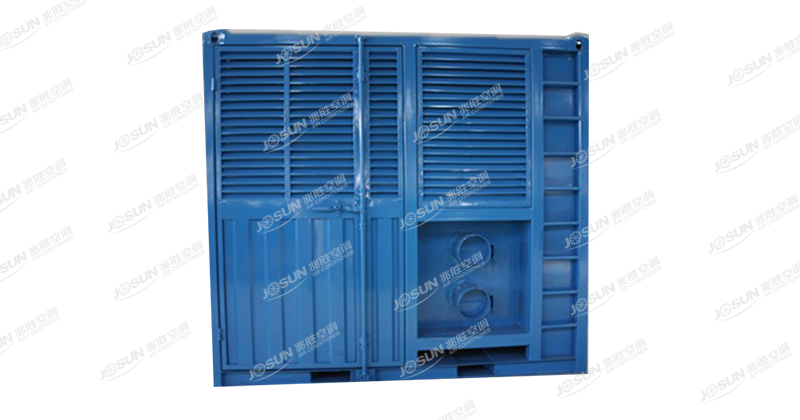
Dehumidifying the enclosed space lets work continue in wet or humid weather. The special combination dehumidifier for painting combines refrigeration and honeycomb desiccant wheel dehumidification in one housing. It has independent dehumidification, cooling, heating and ventilation functions, a compact and sturdy build, high air volume, and is designed for all-weather use.
Cargo holds and tanks
Some cargoes are sensitive to moisture, and tanks must be dried before loading, inspection or coating work. On chemical tankers, oil tankers and dry cargo ships, dry air is supplied to the hold or tank.
The LCZL explosion-proof drive dehumidifier does this with a desiccant wheel. Humid air passes through the wheel, which adsorbs its moisture. The dried air is heated by a secondary heat source and sent into the cargo hold by the processing fan. As the wheel turns slowly, the section holding moisture moves into a regeneration zone, where hot air from the regeneration heater dries it and is discharged outdoors. The main components are an explosion-proof dehumidification wheel, an explosion-proof centrifugal regeneration fan and an explosion-proof centrifugal processing fan, each with an explosion-proof motor, plus the regeneration air heater and the secondary heat source.
Equipment rooms and local conditions
Electrical rooms, control rooms and stores may need humidity held below a set limit while temperature stays within a band. A JCZK combined dehumidifier uses refrigeration to remove moisture and can be fitted with a reheater, a fan and other modules. It can meet local air conditioning needs as well as dehumidification.
Temporary and spot cooling
During outfitting or at a terminal, a closed space may need cooling and dehumidification before its permanent HVAC system runs. The mobile post air supply unit is a portable air-cooled unit that cools and dehumidifies air for temporary work places and small fixed areas, without an installed air conditioning and ventilation system.
Offshore wind installations
Offshore wind turbines, towers, substations and platforms sit in humid, salt-laden air for decades. Enclosed spaces holding electrical equipment are commonly dehumidified to limit corrosion and condensation. The requirement is usually set by the turbine or substation designer.
Josun has supplied environmental control for offshore wind projects; see sea and land wind power solutions. For a dehumidification scope on a wind installation, send the enclosure data listed below and the designer’s humidity limits.
Refrigerant or desiccant
The two technologies suit different conditions. Many coating applications use both in series, as in the combination unit above.
| Refrigerant (condensing) | Desiccant (adsorption wheel) | Combined | |
|---|---|---|---|
| Principle | Cools air below dew point on a coil | Wheel adsorbs moisture; heated air regenerates it | Refrigerant stage then desiccant stage |
| Works best in | Warm, humid air | Cold air and low dew point targets | Wide range of weather |
| Lowest humidity reached | Limited by coil temperature | Low dew points | Low dew points |
| Heat added to the space | Some, from the compressor | Supply air leaves warmer | Can be cooled or heated to suit |
| Needs | Power, condensate drain | Power or heat for regeneration, regeneration air exhaust | Both |
| Typical use | Equipment rooms, local conditioning | Cargo holds, tanks, cold spaces | Tank and block coating |
A refrigerant unit loses effectiveness as the air gets colder, because the coil cannot run far below freezing without icing. A desiccant unit keeps removing moisture in cold air, which is why it is common in winter coating work and for deep drying. The desiccant unit needs a heat source for regeneration and a route to discharge the wet regeneration air outside the space.
Explosion-proof requirements
Cargo tanks, pump rooms and spaces near them may be hazardous areas. Any fan, motor or heater placed in those areas, or in the air path from them, must be suitable for the hazardous zone and gas group that apply.
Check this before selection. The ship’s hazardous area plan defines the zones. State the zone, gas group and temperature class in the enquiry, and where the dehumidifier itself will stand: inside the hazardous area, on open deck, or in a safe space with ducts running to the tank.
How a dehumidifier is sized
Sizing starts from the moisture that must be removed and the dryness that must be reached:
- Volume of the space and how tightly it is closed.
- Target condition: relative humidity, dew point, or the margin to steel temperature set by the coating specification.
- Outside air conditions during the work: temperature and humidity for the worst season expected.
- Air changes and leakage: open hatches, manholes and ventilation openings bring moisture in.
- Moisture sources inside the space: people, wet surfaces, water left after washing.
- Duct runs: length and number of bends to the space, which set the fan pressure.
For coating work, include the steel temperature range and whether heating is needed to keep the steel above the dew point margin.
Fixed or portable
Decide early whether the dehumidifier is part of the ship or a piece of yard equipment.
- Fixed units are installed as part of the ship’s systems. They need foundations, power and control connections, a condensate drain, and permanent ducts. They appear on the ship’s drawings and in the class and owner’s review.
- Portable or containerised units are moved from block to block or from ship to ship. They connect with temporary flexible ducts and a site power supply. The housing must stand up to yard handling and outdoor weather, and the unit should be easy to lift and set down.
For both, ask how the unit is controlled. A humidity sensor in the space, with the unit cycling to hold a set point, uses less energy than running at full output for the whole job.
What to send with your enquiry
Please include:
- Vessel type or installation type (ship, platform, wind turbine, substation), and whether the unit is permanent or for yard use.
- Spaces and heat loads: volume and dimensions of each space to be dried, openings, internal moisture and heat sources, and duct routing.
- Ambient design conditions: outside temperature and humidity range during use, and the target humidity or dew point inside.
- Power supply: voltage, frequency and phases, and any heat source available for regeneration such as steam or hot water.
- Classification society involved and the hazardous area classification of the installation. Class requirements depend on the vessel and must be stated in the enquiry.
- Owner’s standards list: coating specification, owner’s specification and preferred makers list.
Send the data through the contact page. The full range is on the marine dehumidification products page. For air conditioning selection, see our guide on how to choose a marine air conditioning system.