
A ship’s air conditioning system is chosen once, at the design stage, and then lives with the vessel for decades. The choice sets the plant room size, the duct and pipe routing, the number of units the crew must maintain, and how much control each cabin has.
This guide sets out the main system types used on ships, where each one fits, and what data a supplier needs before a proposal can be made.
The three main system families
Most marine air conditioning falls into three families. Many ships combine them: a central plant for the accommodation block and separate units for the wheelhouse, control rooms or remote spaces.
1. Central all-air systems (CAV and VAV)
In a central all-air system, one air handling unit (AHU) treats a mix of fresh air and return air. The conditioned air is ducted to every cabin through terminal units.
- A constant air volume (CAV) system supplies a fixed air volume. Room temperature is controlled from the return air or a typical cabin. It is made up of an AHU, cabin units, a duct system and a control system, and covers the needs of most general ships.
- A variable air volume (VAV) system adjusts the air volume at each terminal according to load, temperature or CO2, and the AHU fan speed follows through a frequency converter. It is used on passenger ships, research ships, government ships and offshore platforms, where lower part-load energy and noise are specified.
The AHU can carry its own refrigeration circuit, as with the CJKR water-cooled AHU and the CJKR(F) air-cooled AHU. It can also be a coil-only unit such as the TMU direct AHU, served by a separate compress-condensing unit when the compressor must sit in a different space from the air handler.
2. Chilled-water systems
In a chilled-water (indirect) system, a marine water chiller produces chilled water. The water is pumped to AHUs and fan coil units, where it cools and dehumidifies the air. Refrigerant stays inside the chiller; only water runs through the ship.
This arrangement suits large accommodation blocks and vessels with many separate terminals. Pipes are easier to route than long refrigerant lines, and the refrigerant charge stays in one place. The trade-off is extra equipment: pumps, expansion and make-up devices such as the rated pressure exhausting and water replenishing device, and water treatment.
The terminals are usually fan coil units in floor-mounted, ceiling, or concealed horizontal and vertical versions. On yachts and smaller vessels, a compact chiller such as the JTLS light water chiller supplies chilled water in summer and heating water in winter.
3. Zoned or decentralised systems (OPTI and IDFC)
In a zoned system, the central plant treats only fresh air. The OPTI system and the IDFC system both deliver treated fresh air through a medium- and low-pressure single duct system. Return air is treated locally by an OPTI unit or an IDFC unit.
The result is individual control per cabin while keeping one central fresh air plant. It suits ships where cabins have different loads or occupants expect their own set point, such as offshore accommodation and passenger areas.
Self-contained, split and packaged units
For small ships, single spaces or areas away from the main plant, a self-contained unit is often simpler than extending the central system. The CLD-B and CLD-C low-noise units treat cabin air directly, and the CLD-BE runs on 100% fresh air. Split units separate the compressor section from the air section when the installation space requires it. The JTZK packaged unit is a small water-cooled direct-expansion unit used on passenger ships, cargo ships, yachts and public service vessels.
Comparison at a glance
| Central all-air (CAV / VAV) | Chilled water | Zoned (OPTI / IDFC) | Self-contained / packaged | |
|---|---|---|---|---|
| What is piped through the ship | Conditioned air | Chilled (and heating) water | Fresh air duct plus water or refrigerant to zone units | Local only |
| Cabin-level control | Limited (CAV) to good (VAV) | Good, per fan coil | Good, per cabin | Per unit |
| Plant room demand | One large AHU room | Chiller room plus AHUs | Fresh air plant plus distributed units | Minimal |
| Typical fit | Cargo ships, work ships | Large accommodation blocks, offshore | Passenger areas, offshore living quarters | Small ships, wheelhouse, remote spaces |
| Main trade-off | Large ducts | More components | More units to maintain | Many small plants on larger ships |
Condenser cooling: water-cooled or air-cooled
Every refrigeration circuit on board has to reject heat somewhere.
- Water-cooled units reject heat into the ship’s seawater or central fresh water cooling system. They can sit anywhere inside the hull, but they need a cooling water connection. The design seawater temperature affects their capacity and must be given in the enquiry.
- Air-cooled units reject heat to outside air. They need no cooling water but must be placed where they can draw and discharge ambient air, usually on an open deck or in a well-ventilated casing.
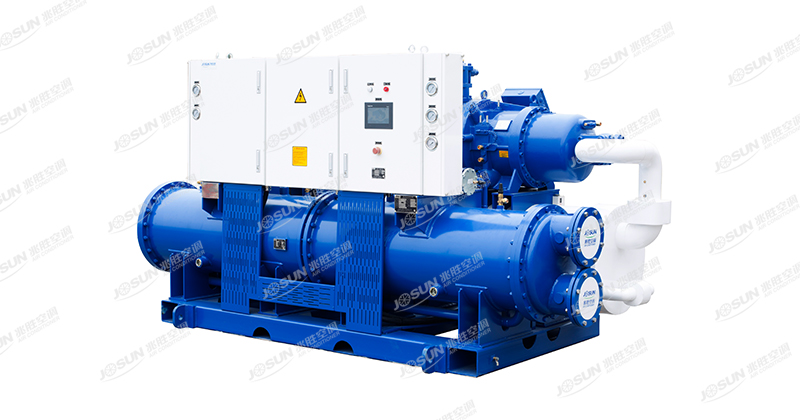
Josun supplies chillers in both forms: the CLS water-cooled chiller and the CLS(F) air-cooled chiller.
Design conditions
Capacity depends on the design conditions more than on anything else. ISO 7547 sets out design conditions and the basis of calculation for air-conditioning and ventilation of accommodation spaces on ships. Many owners and yards use it as a baseline and then add their own values for the trading area.
The enquiry should state, at a minimum:
- Outdoor summer and winter dry-bulb temperature and relative humidity.
- Seawater temperature for summer and winter, for water-cooled equipment.
- Indoor targets for each space type: temperature, humidity, and fresh air rate.
- Noise limits for cabins, offices and public spaces, if the owner specifies them.
- Any polar or tropical operation outside the normal trading pattern.
If a ship will trade in polar waters or in very hot regions, say so early. A research vessel working in ice and a work boat in the Gulf can have the same accommodation layout and very different plant capacities.
Engine rooms are a separate calculation. Their ventilation is often designed to ISO 8861 and handled by the ventilation scope rather than the air conditioning plant.
Heating and dehumidification
Most marine air conditioning systems also heat in winter. The heating source changes the AHU design: electric heating, hot water or steam from the ship’s boiler, or heat pump operation. State which heating media are available on board and whether the owner limits electric heating.
In summer the cooling coil also removes moisture. For spaces where humidity control matters more than temperature, a dedicated dehumidification unit may be needed alongside the air conditioning.
Redundancy and maintenance
Owners often ask for the central plant to be split into two or more units, so that one can be serviced while the other keeps the accommodation cool. Decide this at the start. It affects the plant room layout and the chiller or compressor sizes.
Consider also who will maintain the plant. A few large units are simpler to service than many small ones, but a failure affects more spaces. Zoned and self-contained systems spread the risk and spread the maintenance.
Matching the system to the vessel
- Merchant ships (container ships, bulk carriers, LNG carriers) often use a central AHU with a compress-condensing unit or a water-cooled AHU. See merchant ship solutions.
- Passenger ships and ferries tend towards VAV or zoned systems for cabin-level control and noise. See passenger ship solutions.
- Research vessels combine low noise targets with polar or tropical operation. See scientific research ship solutions.
- Offshore platforms and FPSOs need living quarters, control rooms and modules treated as separate zones. See marine engineering and FPSO.
What to send with your enquiry
A proposal can only be as accurate as the data behind it. Please include:
- Vessel type, size and trading area, and whether it is a newbuild or a retrofit.
- Spaces and heat loads: a list of air-conditioned spaces with area, occupancy and equipment loads, or a general arrangement drawing.
- Ambient design conditions: outdoor summer and winter conditions, seawater temperatures, and indoor targets.
- Power supply: voltage, frequency and phases, and any limits on electric heating.
- Classification society involved and any notation the ship will carry. Class requirements depend on the vessel and must be stated in the enquiry.
- Owner’s standards list: the owner’s specification, noise limits, refrigerant restrictions and preferred makers list.
Send these through the contact page and our engineers will return a system proposal and equipment selection. Our full range is on the marine air conditioning products page.