
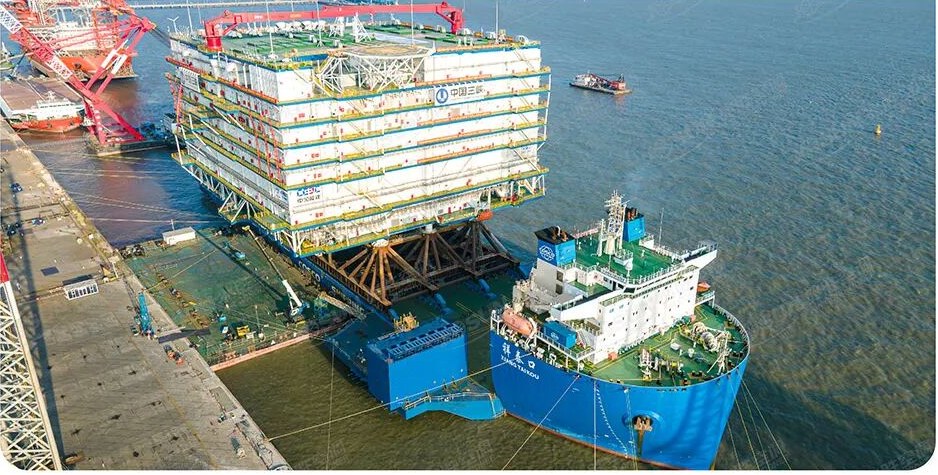
On 27 May 2026 the offshore converter stations for the Qingzhou V and VII offshore wind farms left the fabrication yard for their site off Yangjiang, Guangdong Province. Once installed, the stations collect, convert and export the power from the wind farms. JOSUN supplied the air conditioning for the stations.
The project
The Qingzhou V, VI and VII offshore wind projects off Yangjiang are invested and built by China Three Gorges Renewables, part of China Three Gorges Corporation. Their total installed capacity is 3,000 MW. The wind farms export their power by flexible direct current (HVDC) transmission through offshore converter stations.
The challenge: heat in a closed structure
An offshore converter station packs a large amount of electrical equipment into a closed, space-limited structure. Converting power produces a great deal of heat. The valve hall is the main source, because it holds the densest concentration of power electronics on the station. Without strong and continuous heat removal, that heat builds up quickly and puts the equipment at risk.
The station also sits in open sea for its whole service life. Salt-laden, humid air attacks any equipment that exchanges air with the outside.
What JOSUN supplied
JOSUN designed customized air conditioning around the conditions in each area of the converter stations. The equipment has:
- a high protection rating, for installation on an exposed offshore structure;
- resistance to salt-spray corrosion, for long service in marine air;
- temperature control for the electrical equipment, so the power equipment stays within its working temperature range.
The source article includes photographs of JOSUN environmental control equipment installed on site. It does not list model numbers or capacities.
Related project: Rudong offshore converter station
JOSUN has also supplied the environmental control system for the offshore converter station of China Three Gorges Corporation’s 800 MW Rudong offshore wind project in Jiangsu Province. That project uses flexible DC transmission and 200 wind turbines in the Huangshayang sea area. In August 2026 its cumulative generation passed 10 billion kWh (source).
For Rudong, JOSUN’s work started at the early construction stage and covered:
- scheme design and 3D modelling;
- product selection;
- thermal simulation and cooling design;
- a compact layout of high-protection equipment in the limited space of the station.
In the five years since the station entered service, JOSUN’s service team has kept a 24-hour response arrangement, with regular inspections and maintenance of the station’s HVAC system.
Delivery
The Qingzhou V and VII stations sailed from the yard on 27 May 2026 with the JOSUN air conditioning installed. For JOSUN’s systems for offshore substations, converter stations and turbines, see the sea and land wind power solution.