
Every ship with a crew on board needs somewhere to keep food. On a cargo ship that is a small group of cold rooms next to the galley. On an offshore platform or a large passenger ship it is a full cold store. On a fishing vessel, refrigeration protects the catch, which is the reason the ship goes to sea.
This guide covers what a provision refrigeration plant is made of, the data needed to size it, and how fishing-vessel freezing differs from ordinary provision storage.
What a provision refrigeration plant is
A provision plant has four parts:
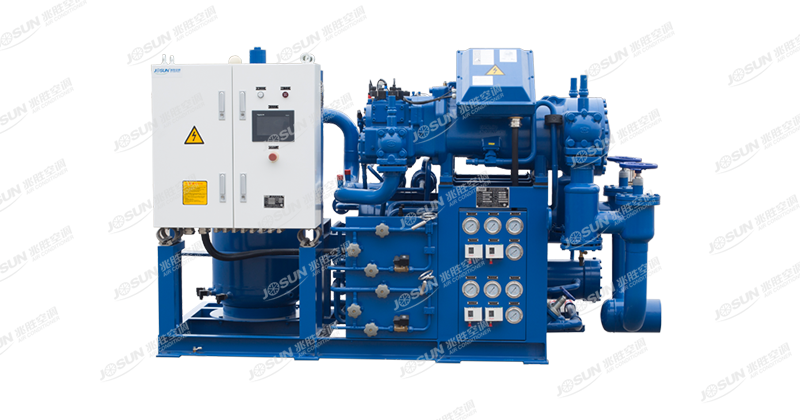
- The refrigeration unit. Compressors, condenser, oil separator, receiver, drier, and the electrical control box, usually built onto one frame. Josun’s marine refrigeration unit and water-cooled modular refrigeration unit are direct-expansion units of this kind, used for food cold storage on ships and oil platforms. They control each cold room to its own storage temperature.
- The cold rooms. Insulated rooms, either built into the ship’s structure or supplied as prefabricated panels. A marine assembled cold storage is delivered as a panel kit and assembled on board.
- The air coolers. An air cooler in each room circulates air through a refrigerated coil to hold the room at temperature.
- Controls and alarms. Temperature control for each room, defrost control, and alarms to the engine control room or bridge.
Rooms and temperatures
A provision plant normally has two temperature groups:
- Frozen rooms for meat and fish.
- Chilled rooms for vegetables, fruit, dairy and drinks, plus sometimes a handling room or lobby.
The two groups run at very different evaporating temperatures. Frozen and chilled rooms are therefore often served by separate circuits or separate compressors, with the controls arranged so that each room can be held at its own set point.
For each room, state the required temperature and any humidity requirement. Vegetable and fruit rooms are sensitive to humidity as well as temperature. Where fresh produce must last longer on long voyages or remote stations, an ice-temperature fresh keeping system or a modified-atmosphere fresh keeping system controls the storage conditions more closely than a standard chilled room.
What sets the plant capacity
Plant capacity is a heat balance for each room. The main inputs are:
- Room size and temperature. Internal dimensions of each room and the target temperature.
- Insulation. Wall, deck and ceiling construction, and what lies on the other side: accommodation, machinery space, open deck or another cold room.
- Product load. How much food is loaded per day and at what temperature. This is the largest variable on fishing vessels.
- Door openings and occupancy. Galley stores rooms are opened many times a day.
- Ambient and cooling water conditions. Engine room or plant room air temperature, and seawater temperature if the condenser is water-cooled.
Crew size and the number of days between provisioning set the room volumes. If the shipyard has only a crew number and endurance, a supplier can propose room volumes, but the owner’s own table of rooms will give a more accurate quote.
Cold room details that affect the quote
Several items are easy to leave out of a specification and then add later at extra cost. Agree them before the quote:
- Defrost method. Air coolers in frozen rooms collect ice on the coil and must be defrosted on a timed or demand cycle. Electric and hot-gas defrost need different components.
- Drains and door heaters. Frozen rooms need heated drain lines and heated door frames so that water can leave the room and doors do not freeze shut.
- Supply boundary. Say who supplies the insulation, the room panels, the doors, the lighting and the piping between the plant room and the rooms. Scope splits between yard and supplier differ from ship to ship.
- Monitoring. Say whether room temperatures must be logged or sent to the ship’s alarm and monitoring system, and in what format.
Redundancy, condenser cooling and refrigerant
Standby. Many owners ask for two refrigeration units, one running and one standby, or two units each able to carry the essential load. This doubles part of the equipment, so decide it at the start.
Condenser cooling. Water-cooled units need a connection to the ship’s seawater or central fresh water cooling system. Air-cooled units need a ventilated space. The choice follows the ship’s cooling water arrangement and where the plant room is.
Refrigerant. State the refrigerant the owner accepts. Owner specifications, flag rules and MARPOL Annex VI limits on ozone-depleting substances all bear on it, and the refrigerant decides the compressor and component selection.
Fishing vessels: freezing the catch
On a fishing vessel, refrigeration is part of the production process. Catch preservation on board can use ice, chilled seawater, salting, super-chilling or freezing, depending on the fishery. Where the catch is frozen, the plant has to bring fresh fish from ambient temperature down to storage temperature within a set time, and then hold it in a refrigerated hold.
Josun builds two types of quick freezer for this.
Plate freezers
The CDSD marine low-temperature quick freezing device is a hydraulic plate freezer. Sorted fish is placed in trays between refrigerated plates, frozen to the set temperature and then moved to the storage room. It consists of a compression condensing unit and the hydraulic plate freezing device, each assembled on its own frame or base to reduce installation work on board. It runs in automatic mode, controlled by the set freezing time, or in manual mode.
Air-blast shelf freezers
The SDX aluminium alloy shelf air-blast quick freezing device blows cold air over product on aluminium alloy shelves. It is designed to the layout of the freezing room. Published parameters are a freezing capacity of 1.0 to 6.0 tonnes per unit and a freezing temperature of -25 °C to -60 °C. Freezing time is up to 36 hours for tuna and up to 7 hours for other catches, depending on tray volume and species.
Plate or air-blast: a comparison
| Plate freezer (CDSD) | Air-blast shelf freezer (SDX) | Provision cold room | |
|---|---|---|---|
| How heat is removed | Contact with refrigerated plates | Forced cold air over shelves | Air cooler in the room |
| Product shape | Regular trays or blocks | Irregular shapes and larger fish | Packaged provisions |
| Main duty | Freeze catch quickly to set temperature | Freeze catch, including tuna | Hold food at storage temperature |
| Space | Compact, on its own base | Built to the freezing room layout | Room or prefabricated panel kit |
| Key sizing input | Tray size, batch weight, freezing time | Tonnes per batch, species, freezing time | Room volume, daily load |
Josun also supplies complete fishing vessel refrigeration systems: matching the refrigeration units to the quick freezers, engineering the full system, and design, manufacture, installation, commissioning and technical support. See fishing vessel solutions.
Offshore platforms and support vessels
Offshore platforms, FPSOs and offshore support vessels carry larger crews and are resupplied on a schedule that weather can delay. Cold store volumes are larger and the standby requirement is usually stricter. See marine engineering solutions and OSV solutions.
What to send with your enquiry
Please include:
- Vessel type, crew number, endurance or days between provisioning, and trading or fishing area.
- Spaces and heat loads: a list of cold rooms with internal dimensions, required temperature, and daily product load. For fishing vessels, the catch species, daily catch, tray size and required freezing time.
- Ambient design conditions: plant room air temperature and seawater temperature.
- Power supply: voltage, frequency and phases.
- Classification society involved and any class notation. Class requirements depend on the vessel and must be stated in the enquiry.
- Owner’s standards list: accepted refrigerants, standby requirement, alarm interface, insulation scope, and preferred makers list.
Send the data through the contact page. The full range is on the marine refrigeration products page.